
A New People
The Unfinished Promise of E Pluribus Unum

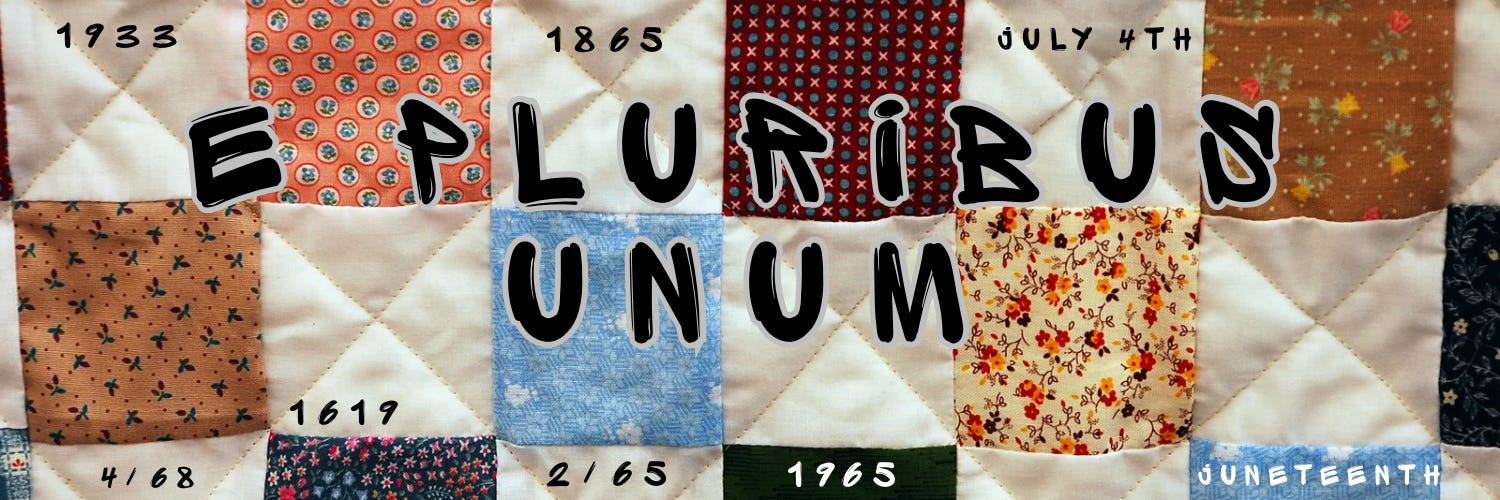
The United States was founded on a paradox: freedom proclaimed alongside bondage, liberty written into law while human beings were written into property rolls. It was a nation conceived in contradiction, yet convinced of its divine purpose. The motto E Pluribus Unum, out of many, one, stands as the loftiest expression of that belief, a statement of unity that has too often rung hollow in practice. While the founders imagined political union, they did not envision moral equality. They sought oneness of state, not oneness of soul.
“Sometimes the most broken parts of a nation carry the clearest reflection of its promise.”
Yet history has a way of revealing truth through its contradictions, and sometimes the most broken parts of a nation carry the clearest reflection of its promise. In a way the founders never intended, the truest expression of E Pluribus Unum emerged from the underside of the American story. The men, women, and children taken from the African continent represented dozens of nations, hundreds of languages, and countless tribal identities. They were not one people when they arrived on these shores. Through the horror of enslavement, the forced crossing of the Atlantic, and generations of survival under the lash and the law, they became something entirely new.
Imam Warith Deen Mohammed once said that we are “a new people,” born of both tragedy and divine possibility. His words reach beyond description; they carry a vision. What he recognized in the African American experience was not only a new identity forged in the furnace of suffering but a model of transformation itself, a living demonstration that out of the many, one can emerge. The very people once enslaved under America’s contradictions reveal the nation’s unrealized potential to become a new people united not by color or conquest but by moral clarity and shared destiny.
The Alchemy of Survival
The Africans who survived the Middle Passage were never meant to meet one another as equals. They were Yoruba and Igbo, Mandinka and Wolof, Akan and Fula, some rivals, some strangers, some kin. The architecture of slavery relied on their separation, on language barriers, and on mistrust. Yet the brutality that sought to divide them forced an unexpected intimacy: a shared song, a borrowed word, a remembered prayer.
Through that crucible, a new cultural grammar emerged. It found its rhythm in the field holler, its syntax in the spiritual, and its theology in the blending of West African cosmologies with the Abrahamic faiths they encountered. Many of those who were enslaved were already people of faith, with scholars estimating that between fifteen and thirty percent were Muslims who carried with them the memory of prayer, literacy, and a moral code rooted in mercy and discipline. These traces of Islam joined with other African traditions and the forms of Christianity they would later encounter, producing a faith practice and worldview that were both ancient and new.
Over time, those fragments formed a coherent language of survival, not only linguistic but moral. They made community where there was none, and kinship where kin had been stripped away. In the plantation’s shadow, they built a moral order rooted in endurance, mercy, and hope.
“What was meant to erase identity instead created a people whose very existence bore witness to the possibility of resurrection in this life.”
Their survival was not only physical but spiritual. In the quiet rituals, remembered prayers, and shared resistance, faith became a form of both preservation and identity. This transformation was not passive. It was an act of collective genius and faith, an unacknowledged miracle. What was meant to erase identity instead created a people whose very existence bore witness to the possibility of resurrection in this life.
The Spiritual Geometry of “Out of Many, One”
When Imam Warith Deen Mohammed described African Americans as “a new people,” he did not simply name a social condition; he named a divine pattern. He saw in our emergence from enslavement a reflection of how God brings unity out of fragmentation and order out of chaos. In Qur’anic terms, it is the process by which difference becomes the raw material of oneness: “We created you nations and tribes so that you may know one another.” (49:13)
That verse reframes E Pluribus Unum as more than a civic motto; it becomes a sacred echo. Both ideas recognize plurality not as a problem to be solved but as a sign to be understood. Out of many tribes, tongues, and temperaments, a single human family was meant to emerge, not through domination, but through recognition.
Seen through this lens, the African American experience is not only a story of survival but a revelation of what America might yet become. If those who were violently divided could create unity under the most inhumane conditions, what excuse remains for a free nation to cling to the color line? The task that began in the quarters and fields remains unfinished. The moral work of unity did not end with emancipation; it is the inheritance of the entire nation.
Toward a New Peoplehood
The phrase “a new people” has implications far beyond race. It calls for a moral evolution of the entire society. America’s next transformation cannot come from technological progress or political reform alone. It must come from spiritual maturity, from a collective willingness to see difference without hierarchy and power without domination.
Imagine an America that finally fulfills its founding aspiration, where E Pluribus Unum is not an inscription on currency but a covenant among human beings. Such a transformation would not erase color; it would erase the lie that color determines worth. It would not ignore the past; it would redeem it by drawing wisdom from its wounds.
The African American community, as Imam Warith Deen Mohammed taught, stands as both witness and teacher in this unfolding story, proof that people can be remade and identity reconstructed on higher moral ground. In our becoming, we carry the blueprint for national rebirth.
The Road Map Hidden in the Wound
The same soil that bore slavery also bore a people who refused to be broken. The same republic that codified inequality still holds the possibility of reconciliation. The wound that defines America’s past might yet become the womb of its renewal if it learns from those who turned captivity into culture and suffering into soul.
If E Pluribus Unum was ever to become more than a phrase, it would require the humility to learn from those who lived its truth under bondage. To speak of a “new people” is not to deny difference; it is to honor the divine rhythm that turns difference into harmony. It is to affirm that the experiment of America, long disfigured by race and hierarchy, still carries the potential to become what it claimed to be: a nation that lives the sacred geometry of E Pluribus Unum, out of many, one.
If the enslaved could become a new people, what is stopping the free?